
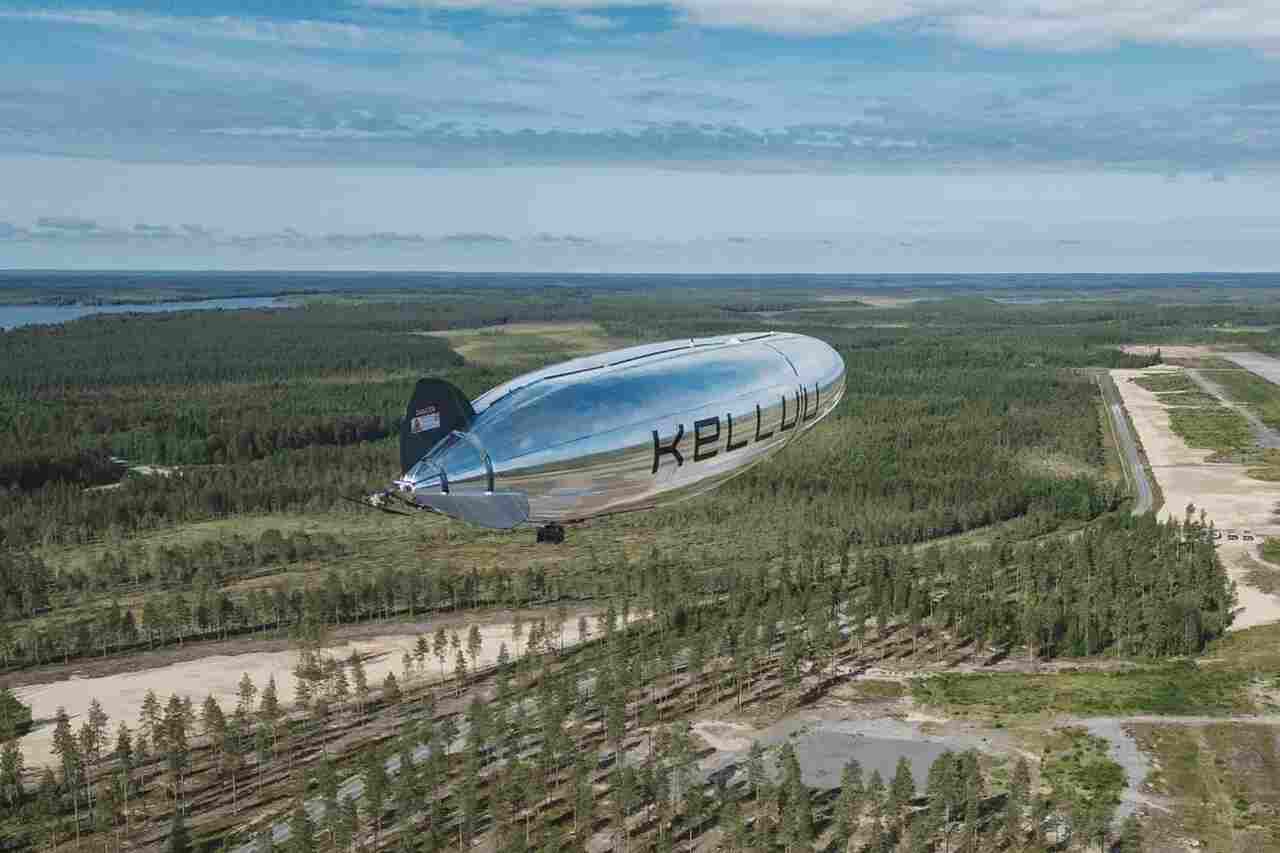
Kelluu, a Finnish company based in Joensuu, a city near the border with Russia, tested its new generation of air balloons for monitoring missions.
According to information shared by Business Insider, the company received a contract under a NATO innovation program for the development of these aircraft.
‘s air balloons are the size of a city bus and only two meters wide, making them much smaller than traditional zeppelins.
The aircraft use hydrogen, which simultaneously provides lift and powers the propeller. According to engineers, the devices can remain in the air for up to 12 hours, exceeding the capabilities of most drones.
They can carry an additional payload of up to 5 kg, including cameras, radars, or other sensors. Their top speed is 53 km/h, and their low cost and ease of production make it possible to deploy entire fleets without the risk of significant financial loss if multiple units are lost.
But their main strength lies in their ability to resist electronic interference. Due to their proximity to the Russian border, the Kelluu team constantly faced interference and signal spoofing.
These conditions created the perfect scenario for designing and testing devices capable of operating even under intense electronic warfare conditions.
Another notable feature of Kelluu’s balloons is their ability to withstand low temperatures. In the region, winter temperatures can drop to –26°C, so the devices are designed to fly in cold and strong winds.
These attributes could prove essential for NATO in future monitoring missions in the Arctic.
In the future, the company also plans to develop airships capable of carrying out multi-day missions with minimal operator intervention.
“We hope to soon have an asset capable of performing multi-day missions, which means even fewer people are needed in the field,” said Niko Kuikka, head of engineering at the startup, to Business Insider.
Photo: Kelluu. This content was created with the help of AI and reviewed by the editorial team.
